One Message, Five Languages: Do We Really Understand Ayurveda?
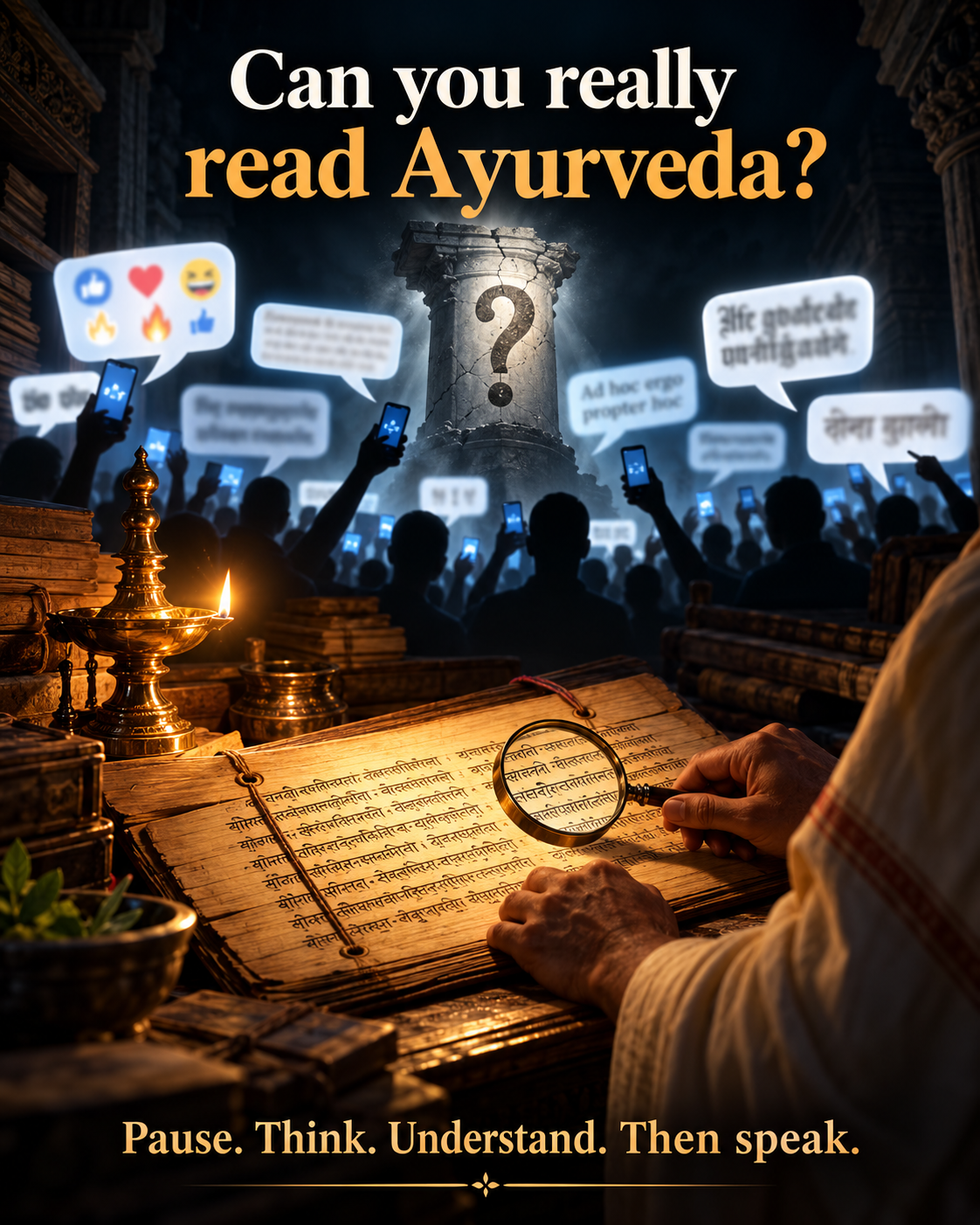
One Message, Five Languages: Do We Really Understand Ayurveda?
| Dr. Aakash Kembhavi | MD (Ayu-Shalya), PGDMLS, MS (Counseling & Psychotherapy) | Academician, Clinician & Researcher | Chief Editor, International Journal of Ayurveda |
Disclaimer: The views in this article are my personal opinions. They do not represent any institution I am or have been affiliated with, and nothing here is medical advice; please consult a qualified physician for your health concerns. In the spirit of transparency, integrity and honesty: this article was developed in collaboration with AI tools, which helped with research, structuring, drafting and rendering the text into different languages. The idea, the views and the final conclusions remain my own.
Preface: Before You Read Further
What follows is one message written five times: in Gen Z and Gen Alpha slang, in Shakespearean English, in Victorian prose, in Latin, and in Sanskrit.
The argument never changes. Only the language does.
Try an experiment as you read.
Some versions will feel instantly familiar; others will feel like noise. Very few readers will move comfortably through all five. And even in plain English we often read what we expect rather than what is written, agreeing or objecting before we have understood.
That is the point. Understanding is not automatic.
It takes literacy in the language, patience with the structure, and the humility to say, “I did not follow that.”
If this is true of a few paragraphs, how much truer is it of the Samhitas, composed in a language most of us meet only in translation, in a style of reasoning most of us were never trained to follow?
Yet we speak of Ayurveda with remarkable confidence. Rarely do we pause to ask the prior question: what, precisely, is Ayurveda, and have we understood it well enough to say?
I. In the Voice of Gen Z and Gen Alpha
Okay fam, vibe check. Real Ayurveda isn’t a 5 a.m. warm-water reel. It’s a method. The Samhitas are basically a rulebook on how to think, and the big idea is Pramana (observation, inference, trusted testimony) plus Yukti, reasoning that fits the context. “It’s in the ancient texts so it’s true” is the least Ayurvedic take possible. The texts want receipts.
Meanwhile fake Ayurveda is giving mid: ancient equals true, one herb cures everything, natural means safe, doshas as a zodiac quiz, remedies from random reels. The ingredient travels, the prestige stays behind, and the value gets captured elsewhere. And the system is on NPC mode: exams reward cramming, research ticks boxes, regulation polices paperwork.
Gen Z and Gen Alpha, you’re the future vaidyas, patients and creators, and AI can write a confident wellness post in three seconds. So ask for receipts, learn the thinking and not just the content, respect without worship, demand better research, and put patients first.
Ayurveda isn’t cooked. But if we let hype run the show, it will be. Slay responsibly.
II. In the English of Shakespeare
Good reader, lend me thine ear. I come not to bury Ayurveda, nor to crown her with garlands undeserved, but to speak plainly, for I love her too well to flatter.
The Samhitas are no apothecary’s catalogue but a school of right reasoning: Pramana, the means of true knowing, and Yukti, judgment fitted to time, place and person. He who cries, “It is written, therefore it is true,” speaketh against the very books he honours, for those books demand proof.
Behold the counterfeit coin: antiquity mistaken for truth, one herb for every malady, “natural” made a synonym for “safe,” the doshas turned to horoscope, cures flung abroad by strangers for the applause of the crowd.
The herb travelleth far while its honour tarrieth at home. And within our own house the schools rear parrots, the studies are many and feeble, and much parchment is stamped while the patient’s welfare is forgot.
Ye young, ye are the physicians of days to come.
Demand your proofs, learn the method, honour without idolatry, and guard the patient first.
Ayurveda is not yet undone; but if fashion rule the stage, undone she shall be. Exeunt, with honest hope.
III. In the Prose of the Victorian Essayists
It is a circumstance not unworthy of remark that, in an age which prides itself upon its facility of communication, the more widely a subject is discussed, the more thoroughly it is apt to be misunderstood.
Of no science is this more lamentably true than of Ayurveda, praised by multitudes who have never read her and condemned by multitudes who have never understood her.
She is not a collection of recipes. The great Samhitas are treatises upon the discipline of the mind, resting upon Pramana, the legitimate sources of knowledge, and Yukti, reasoned and circumstantial judgment. It follows, with a necessity which no sophistry can evade, that whoever declares a matter beyond dispute merely because it stands in the ancient books is the least faithful of their disciples.
A debased currency circulates: the sovereignty of antiquity, the universal specific, the idolatry of the natural, the doshas degraded to a parlour-game.
And the defects lie within our own household: instruction by rote, research composed to satisfy a form, administration solicitous of paper rather than of learning.
To the rising generation I say: require the evidence, acquire the method, revere without idolatry, and put the patient first. I have the honour to remain, with undiminished hope, the faithful servant of the cause.
IV. In Latin
Ayurveda non est catalogus herbarum, sed ratio cogitandi. Samhitae Charakae, Sushrutae, Vagbhatae medicum docent quomodo aegrotum observet, quomodo ratiocinetur, quomodo veritatem ab opinione discernat. Fundamentum est Pramana, id est modi cognoscendi legitimi, et Yukti, iudicium rationale ad tempus, locum, personamque accommodatum.
Qui dicit, “In libris veteribus scriptum est, ergo verum est,” contra ipsos libros loquitur; illi enim probationem exigunt.
Hodie falsa Ayurveda late spargitur: antiquitas pro veritate habetur, una herba omnibus morbis mederi dicitur, quod naturale est innocuum putatur, doctrina de doshis in ludum horoscopicum vertitur. Nec solis hostibus culpa tribuenda est: in scholis memoria nimis, ratio parum exercetur; in investigatione studia formae satisfaciunt, non quaestioni respondent.
Iuvenes, probationes exigite, methodum discite, sine idololatria venerate, aegrotum ante omnia tuemini.
Ayurveda neque credulos neque contemptores desiderat, sed cogitantes. Valete, cum spe honesta.
V. In Sanskrit
आयुर्वेदः केवलम् ओषधीनां सूची नास्ति; सः सम्यक् तर्कणायाः पाठशाला अस्ति। चरकसुश्रुतवाग्भटैः विरचिताः संहिताः वैद्यं शिक्षयन्ति: रोगिणं कथं निरीक्षेत, सन्दिग्धं वचनं कथं परीक्षेत, सत्यं च कथं निश्चिनुयात्। आधारः प्रमाणानि युक्तिः च।
अतः यः वदति “पुरातनेषु ग्रन्थेषु लिखितम्, अतः सत्यम्” इति, सः येषां ग्रन्थानाम् आदरं नाटयति तेषाम् एव विरुद्धं भाषते; ते हि ग्रन्थाः प्रमाणं याचन्ते।
अद्य कूटायुर्वेदः प्रचरति: यत् प्राचीनं तत् सत्यम् इति गण्यते, एकैव ओषधिः सर्वरोगहरा इति घोष्यते, “प्राकृतम्” इति शब्दः “निरापदम्” इत्यस्य पर्यायतां नीयते, दोषाः जन्मपत्रिकायां परिवर्तन्ते।
स्वगृहे अपि दोषाः सन्ति: पाठशालासु स्मृतौ अतिप्रयासः, चिन्तने अल्पप्रयासः; अनुसन्धाने प्रश्नस्य उत्तरं विना प्रक्रियापूर्तिः।
युवजनाः, प्रमाणं याचध्वम्, पद्धतिं शिक्षध्वम्, आदरं कुरुत, अन्धभक्तिं मा कुरुत, रोगिणं सर्वेभ्यः पूर्वं रक्षत। आयुर्वेदस्य न अन्धविश्वासिभिः प्रयोजनं, न क्षुद्रनिन्दकैः; चिन्तनशीलैः तस्य प्रयोजनम्। सर्वे सुचिन्तयन्तु; शुभं भवतु।
Epilogue: Is It Not Time to Wake Up?
If you struggled with any of the versions above, you have understood the thesis better than any argument could have taught it.
We cannot grasp a message in a language we have not learned.
Yet in Ayurveda we routinely behave as though fluency were optional, as though pride in the tradition could stand in for knowledge of it.
Consider what we actually do.
We claim, without stopping to ask what a text says, in what context, and for whom.
We retrofit: we take a modern finding, hunt for a verse, and declare that the Acharyas knew it all along, ignoring everything in the verse that does not fit.
We commit the familiar fallacies: the appeal to antiquity, the appeal to authority, the appeal to nature, confirmation bias, cherry-picking.
And we say we hold the answers to everything, a claim no honest science makes of itself.
Meanwhile, the work that would truly honour the Acharyas remains largely undone. They left us hypotheses about disease, drugs, diet and the course of illness. A hypothesis is an invitation to be tested. **Charaka himself devoted a whole section to the rules of debate and the faults of argument. **To declare these hypotheses true without testing them is to treat them as dogma.
To test them honestly, and to report what we find whether it flatters us or not, is to treat them as knowledge worth having.
There are honourable exceptions, but they are exceptions.
Waking up does not require abandoning the tradition. It requires a few plain disciplines:
- Pause before claiming. Ask what Ayurveda actually says, and what I am merely assuming.
- Read the source, not the summary. Go to the text and its reasoning before quoting it.
- State the Acharyas’ claims as testable hypotheses. Say what would count for them and what would count against.
- Generate honest evidence. Design sound studies and publish the results, including the disappointing ones.
- Name our fallacies, starting with our own. Spot the retrofit and the appeal to antiquity in our writing before we spot them in others’.
- Teach the question before the answer. Train students to ask “How do we know?” before they memorise “What is the answer?”
Ayurveda has survived for centuries, and it will not be saved by louder claims.
It will be saved by readers: people willing to learn its language, follow its reasoning, test its propositions, and say “we do not yet know” when that is the truth.
In slang, in Shakespeare, in Latin or in Sanskrit, the message is the same.
Pause. Think. Understand. Then speak.
Share your thoughts in the comments below.
💬 Comments & Discussion