Ashwagandha Covid Trial Summary Article: Before You Forward That Press Release: A Short Reading of the Ashwagandha–Covishield Trial
Before You Forward That Press Release: A Short Reading of the Ashwagandha–Covishield Trial
Dr. Aakash Kembhavi
| MD (Ayu-Shalya), PGDMLS, MS (Counseling & Psychotherapy) | Academician, Clinician & Researcher | Chief Editor, International Journal of Ayurveda |
Disclaimer and AI-collaboration disclosure. The views expressed in this article are my personal opinions. They do not represent the views of any institution, journal, organisation or body with which I am or have been affiliated, and nothing in this article is medical advice. In the interest of transparency, integrity and honesty, I also state that this article was developed in collaboration with AI tools, which I used for research, structuring and drafting. The idea, the judgements, and the final views and conclusions are my own. This is a short summary of a longer analysis. Figures are taken from the published paper, its protocol, its supplementary files and the trial registry, and readers are encouraged to check them against the originals.
Read first, believe later
It is high time we read and analysed whatever research is being shared in the press and on social media before we believe it or forward it.
This applies to Ayurveda and to modern medicine alike.
A press release is written to be shared.
A headline is written to be remembered. Neither is written to be checked.
Our community has learned, rightly, to be wary of sweeping claims made against Ayurveda.
We should be equally wary of sweeping claims made on its behalf.
A claim that cannot survive a careful reading does Ayurveda no favours.
So question everything that is put out: who did the study, what was it designed to show, what was measured, what was left out, and who benefits from the headline. Scientific temper is not hostility. It is the habit of asking before accepting.
Let me show what that habit looks like with one example that is being widely forwarded this week.
The headline
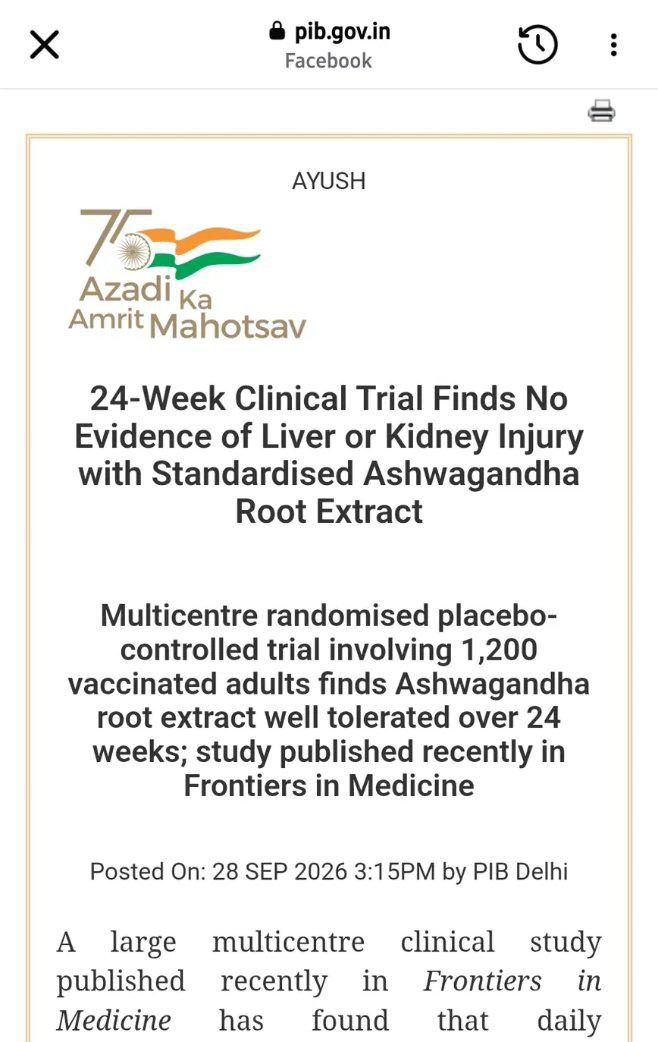
A Ministry of Ayush press release of 28 September 2026 announces that a 24-week trial found no evidence of liver or kidney injury with a standardised Ashwagandha root extract.
The trial gave 500 mg of an aqueous root extract, said to be equivalent to 4 grams of root powder, or a placebo, to 1,200 adults who had received Covishield, at seven sites.
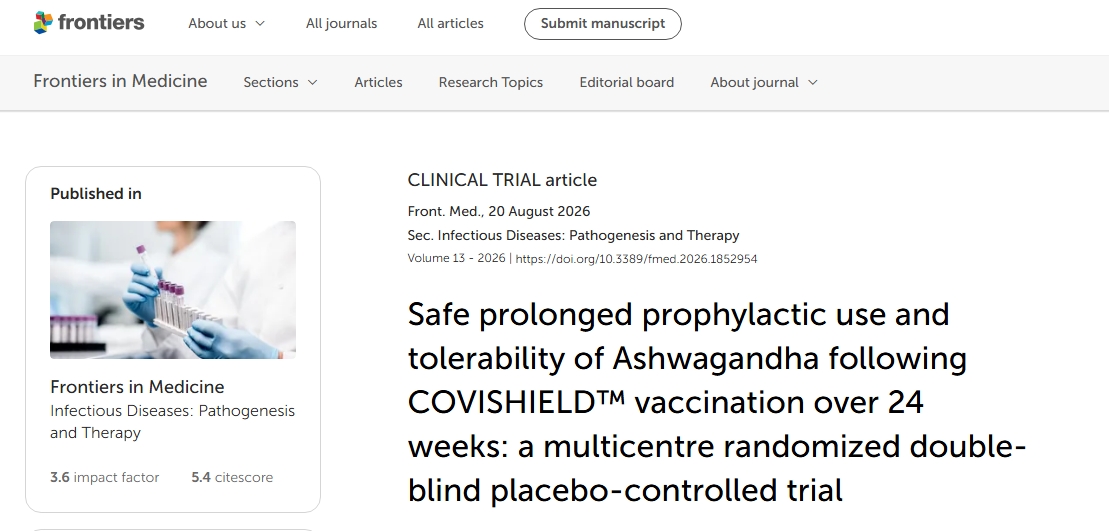
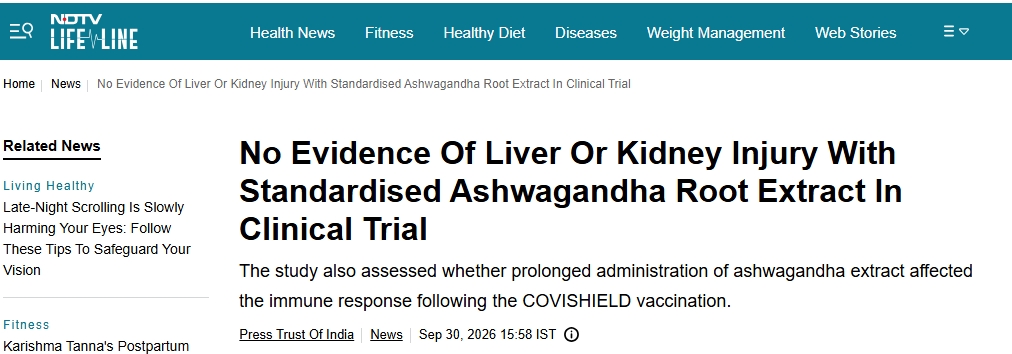
It was published in Frontiers in Medicine in August 2026. Forwarded on social media, this becomes: Ayurveda proven safe.
I read the full paper, its 2022 protocol, the supplementary files and the trial registry entry. Here is what I found.
What the trial was built to do
The registry entry, made in June 2021, is titled Enhancing protective action of COVID-19 vaccine by using Ashwagandha.
Its primary outcome is the antibody response to the vaccine, and safety is a secondary outcome.
The trial was designed as a Phase 3 superiority trial to show that Ashwagandha improves vaccine response.
It did not.
Antibody levels and breakthrough infections did not differ between the groups, and the paper’s own abstract says the **immunogenic effect could not be demonstrated. **
The published title, and the press release, now lead with safety, a secondary outcome.
The paper describes the original primary outcome as exploratory.
What the data can and cannot support
The safety dataset is useful. Healthy volunteers with a mean age of about 29 took one particular tablet for 24 weeks, and no serious adverse event was attributed to it.
That is a reasonable tolerability signal for that tablet in that population.
It cannot carry more than that, for several reasons.
- The trial was not powered for safety. With about 600 people exposed and no serious liver event, the statistical upper bound on the true rate is roughly 1 in 200. Rare idiosyncratic liver injury would not be seen in a trial this size.
- Abnormal liver-function events were numerically more frequent in the Ashwagandha arm (12 events in 6 participants against 4 in 3). They were mild, but they appear beside a headline that says no liver injury.
- Laboratory data are reported as group averages, for completers only. Fourteen percent of participants left the trial, and 145 of the 168 who left simply withdrew consent or were lost, with no reason recorded.
- The laboratory table the paper cites as Supplementary Table S1 is not in the supplement. In the files, S1 is a quality-of-life table, and there is no laboratory table at all.
No evidence of injury is not the same as evidence of no injury. Read this again and again.
Where the paper and its own tables disagree
- The one positive result is an artefact. The abstract mentions a persistently higher antibody level after the first dose. That subgroup has 122 people. Its actual antibody levels were higher in the placebo arm at every time point. The 20 to 40 percent higher figure comes from change over baseline, and the Ashwagandha arm started 25 to 33 percent lower.
- The design changed on paper. The age range is 18 to 45 in the protocol, 18 to 65 in the registry and the methods, and 18 to 70 in the abstract and press release. The booster group was already in the registry in July 2022, but the paper says it was added after enrolment fell in January 2023.
- Planned items are missing. Antibody results appear at four of the seven registered time points. Adherence data, seroconversion rates, serum neutralisation results, the planned interim analysis and the Ayurvedic assessments (prakriti, dhatusarata, agni) are not reported.
- Arithmetic does not reconcile. Serious events are called 0.08 percent, but 8 of 1,200 is 0.67 percent. Baseline prior infection is called comparable (p = 0.50) in the text, but the table says p = 0.01. Symptomatic infections are 11 in the text and 22 in the table.
- Some values need the raw data. One standard deviation in the quality-of-life supplement is mathematically impossible for that score. Height spreads of 17 to 22 cm in the placebo groups sit beside 9 to 10 cm elsewhere. One supplementary column is repeated digit for digit under another heading.
- The registry was never brought up to date. It still shows recruitment as closed, an estimated duration of one year and no publication, years after the trial ended.
This is not how we use Ashwagandha
In Ayurvedic practice the root is used as churna, arishta, ghrita or in compound formulations, with an anupana, at doses individualised to the patient.
The trial used a fixed 500 mg film-coated tablet of an 8:1 water extract, once a day, for everyone.
Nor is it what is sold in the market.
By the sponsor’s own quality sheets, the extract holds about 0.3 percent total withanolides. That is roughly 1.5 mg per tablet, and the finished tablet assays at about half of that.
Typical commercial extracts are quoted at 1.5 to 5 percent, which is 7.5 to 25 mg in the same dose.
The raw root’s total alkaloids were 0.048 percent against a specification of at least 0.3 percent, yet the sheet records compliance.
The chromatograms are dated 2019, and no lot or expiry details are given for the trial tablets.
So the safety finding belongs to this tablet. It should not be carried over to classical preparations or to the supplements people buy.
The Danish question
Denmark banned Ashwagandha in food supplements in 2023 after a risk assessment by its Technical University raised concerns about thyroid and sex hormones. Germany’s risk assessment body has advised pregnant and breastfeeding women, children and people with liver disease to avoid it. The Danish work has its critics, and the science is contested.
The paper says the Danish signals were not observed in this study. But the trial did not measure thyroid function or sex hormones, and the words thyroid, hormone and pregnancy do not appear in the paper.
The Danish report is not among its 44 references.
The sentence is sourced to the NIH fact sheet and the Ministry’s own safety dossier, which was written to answer the Danish concerns.
A signal cannot be not observed if nobody looked for it. The trial provides no information on Denmark either way. The preserved serum samples could still be tested for thyroid and sex hormones, under blinding.
A disclosure question
The website of the World Ashwagandha Council lists one author of this paper as its Executive Director, in an honorary role, and four more authors on its advisory board. The Chief Patron of that board is the Ministry’s Secretary, who is thanked in the paper’s acknowledgements. The board also includes the founder of the company behind the KSM-66 Ashwagandha extract, and the Council’s published address and phone number match those that trade press lists for that company. The paper’s conflict-of-interest statement mentions none of this. I found no indication that any company funded the trial, and the paper says the Ministry’s research council did. Honorary and advisory roles are often unpaid, and I do not suggest that anything improper followed. But readers should be able to see them.
What I am not saying
I am not saying the trial is worthless.
A registered, randomised, placebo-controlled, multicentre trial is serious work, and Ayurveda needs more of it.
I am not alleging fabrication or fraud, and a paper alone cannot show intent.
Other readers have raised some of the same numerical points, and the inconsistencies may well be clerical. But they mean the tables cannot be relied upon until they are checked against the raw data, which the registry says will be shared.
This is a reading of a paper, offered in the spirit of scientific temper. It is not an allegation or an insinuation against any person or institution. I would rather put specific questions to the authors, and ask the journal and the Ministry to answer them in public.
Five questions to ask of any research post
- Was this the question the study was registered to answer? Compare the headline with the registry entry.
- Who was studied? Healthy young volunteers do not tell you about your older patient with liver or thyroid disease.
- What exactly was given? The herb, a classical preparation, an extract and a tablet are four different things.
- What was measured, and what was not? Absence of a finding is meaningless if nobody looked.
- Who is involved, and who benefits from the headline? Funding, advisory roles and commercial interests should be visible.
If you want the full analysis
The full-length critical analysis of this paper, section by section, runs to more than twenty pages. If you wish to read it, please write to me at drkembhavi@astangawellness.com, and I will be glad to share it.
And the next time a headline arrives on your phone, whether it praises Ayurveda or condemns modern medicine, read it, check it, and then decide whether to forward it.
Share your thoughts in the comments below.
💬 Comments & Discussion