The Highway to Nowhere: Ayurveda's Infrastructure of Motion Without Destination
The Highway to Nowhere: Ayurveda’s Infrastructure of Motion Without Destination
Dr. Aakash Kembhavi
| *MD (Ayu-Shalya), PGDMLS, MS (Counseling & Psychotherapy) | Academician, Clinician & Researcher | Chief Editor, International Journal of Ayurveda* |
Disclaimer
The views expressed in this article are the author’s personal opinions, formed through his individual academic and clinical experience, and do not represent the official position of any institution, journal, organisation, or body with which he is affiliated. This article is intended for academic reflection and discussion and does not constitute medical advice of any kind. This article was developed in collaboration with AI tools, which assisted with research support, structuring, and drafting; the underlying ideas, arguments, and final conclusions remain the author’s own.
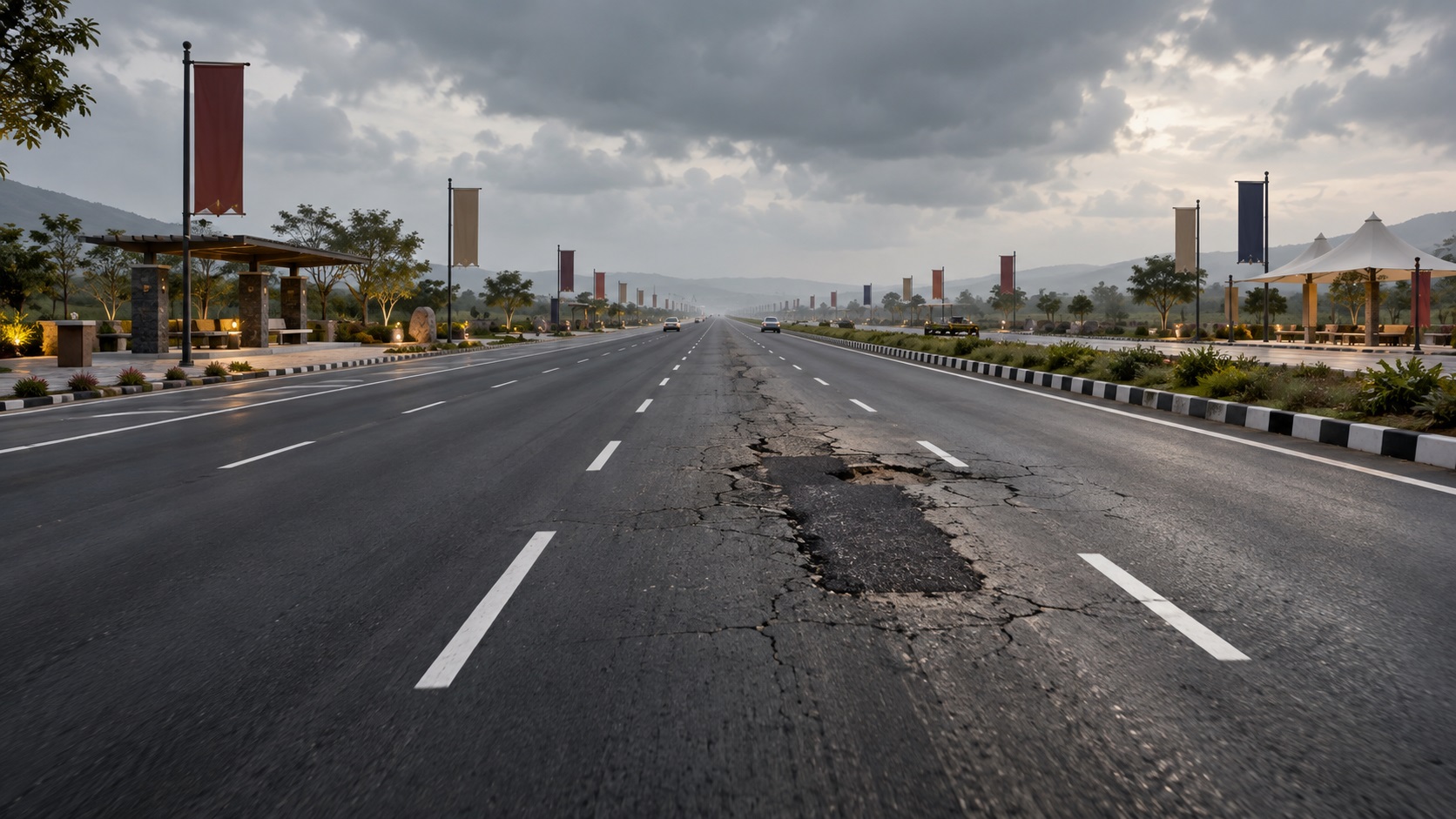
There is a stretch of road I keep returning to in my mind whenever someone hands me a brochure for the latest “Centre of Excellence” or forwards me the concept note for another international conclave.
It is a beautiful road. Freshly tarred, cleanly marked, well-lit at night, with signage in three languages and a toll plaza that runs efficiently.
Drive past it at 100 kilometres an hour and you would call it, without hesitation, a triumph of infrastructure.
Ayurveda, as a public system today, is that road.
The trouble starts the moment you slow down — or the moment the monsoon arrives.
A little wear, a little water, and the surface gives way faster than it should.
Underneath the bitumen there was never quite enough aggregate, never quite enough compaction, never quite enough of the unglamorous engineering that makes a road survive its own traffic.
What follows is familiar to anyone who has driven on any Indian highway: a pothole appears, someone notices, and instead of being repaired, it is patched — a shovel of loose mix, tamped down just enough to pass a visual inspection, just in time for the minister’s convoy or the site visit. It will not survive the next rain. It was never meant to. It was meant to survive the next photograph.
This essay is an attempt to walk that road slowly, as a critical insider rather than a passer-by, and to ask the question that the brochures never ask: where, exactly, does this highway lead?
Nobody Has Named the Destination
Ask anyone inside the Ayurveda establishment what “success” would concretely look like — not as a slogan, but as an operational endpoint — and watch the answer dissolve into abstraction.
Global acceptance? Integration with modern medicine?
A Nobel Prize for a molecule extracted from a classical formulation?
Ayurveda taught with the same evidentiary rigour as any other clinical science?
Each of these is a direction, not a destination, and each implies a different road, a different set of on-ramps, a different definition of who gets to travel on it.
We have spent decades building the road without first agreeing on the map. That is not a technical failure; it is a governance failure, and it is the reason every subsequent failure on this list feels forgivable in isolation and catastrophic in aggregate. A pothole on a road to nowhere is, after all, just scenery.
The Stops Along the Way
What we have built instead of a destination is an impressive collection of stops — way-stations that generate the feeling of movement without requiring anyone to arrive anywhere. It is worth naming them plainly, because their sheer number is itself the point.
- Institutions inaugurated with considerable ceremony, whose actual output — papers, patents, protocols, trained clinicians — is thin enough to fit on a single page, if anyone ever asked for that page.
- Memoranda of Understanding, signed between universities, ministries, and foreign institutes, that exist as PDFs and press releases and almost nothing else — no joint publication, no exchanged student, no shared protocol, three years on.
- An annual calendar of seminars and conferences whose primary deliverable is a certificate of participation, printed on heavy paper, framed by people who never once open the proceedings volume.
- Ayurveda Day, celebrated with rangoli competitions and inaugural addresses, in institutions that could not tell you, if pressed the next morning, what changed in their curriculum, their research output, or their patient outcomes because of it.
- The World Ayurveda Congress and its regional imitators — international conclaves with sophisticated branding and workshop titles borrowed from the vocabulary of systems biology and precision medicine, generating panel photographs and hashtags in volumes that outstrip, by orders of magnitude, any generated hypothesis, trial, or falsifiable claim.
- Toll plazas that collect without returning: journals that publish without meaningful peer review, “Fellow of” certifications with no assessed competency behind them, accreditation visits that inspect files rather than practice.
- Milestone boards with invented distances — the round, reassuring statistics quoted in every keynote (crores treated, percentage growth in AYUSH exports, number of registered practitioners) that nobody in the room has ever traced back to a primary, auditable source.
- **Flyovers built to bypass the traffic jam rather than clear it **— a “Centre of Excellence” for pharmacovigilance or standardisation, announced precisely when the underlying problem becomes too visible to ignore, allowing everyone to drive over it rather than look down at it.
Consider, as a live and recent example rather than an abstraction, the “Strategic Roadmap for Making Ayurveda Global” released by NITI Aayog in mid-2026, prepared with a global consultancy and unveiled with the customary complement of secretaries, members, and senior officials.
It is built around a tidy three-pillar architecture — Availability, Acceptability, Propagation — and a phased strategy stretching out to 2047, deliberately timed to the horizon of Viksit Bharat.
It is, by every visual measure, an impressive document: comprehensive, well-branded, aligned to the right national vision, launched at the right podium.
The uncomfortable question it deserves is not whether its pillars are the wrong pillars — they may well be the right ones — but whether the document tells us who is accountable if 2035 arrives and Availability, Acceptability, and Propagation have each advanced by a polite few percentage points while the underlying pharmacovigilance, trial rigour, and curriculum questions remain exactly where they are today.**
A roadmap that names a destination and a timeline, but not a mechanism for course-correction or consequence, is not yet different in kind from the milestone boards already lining this highway.
It may simply be the most well-designed one erected so far. Whether it becomes an actual stretch of road or the most sophisticated stop yet is a question this article cannot answer in 2026 — only note as one worth re-asking in a decade.
Each of these stops is defensible on its own terms.
Nobody attends a single seminar with dishonest intent.
The damage is cumulative, structural, and almost entirely invisible from inside any one event.
It only becomes visible when you count the stops against the distance actually travelled — and find that the odometer has barely moved in thirty years on the questions that matter most: rigorous trial designs, transparent pharmacovigilance, a curriculum that produces clinicians capable of independent critical reasoning rather than reproduction of memorised shloka and diagnosis categories.
What the Potholes Actually Are
It is easy to gesture at “quality issues” in the abstract. It is more useful, and more uncomfortable, to name the potholes by their actual shape.
- Pharmacovigilance systems that exist on paper, receive negligible reporting, and have never meaningfully altered a formulation or a labelling practice in response to an adverse event signal.
- Clinical trial designs, published in indexed journals, whose sample sizes, blinding, and control arms would not survive a first-year biostatistics viva — yet are cited, uncritically, as “evidence for Ayurveda” in the next conference keynote.
- A postgraduate entrance and evaluation architecture that rewards recall over reasoning, and therefore produces scholars fluent in citation and unpractised in doubt.
- Research output measured in publication count rather than replication, falsifiability, or clinical consequence — a metric that a determined mediocrity can satisfy indefinitely.
- A curriculum reform process (competency-based, on paper) that has changed documentation more than it has changed what happens inside a classroom.
None of these are secrets.
Every person reading this who has sat on a review committee, examined a thesis, or reviewed a manuscript for a journal has seen at least one of them directly, at close range, without exaggeration.
Counting the Actual Lanes
Metaphors are useful until someone asks for the traffic count, so it is worth pausing the highway image and asking a plain infrastructural question: how many actual institutions and seats exist to train the people this system is supposed to run on — the BAMS graduates, the MD/MS specialists, the PhD scholars — and who is building them?
The honest answer is that no single, centrally published, year-specific census makes this trivial to state with full confidence, which is itself worth noting for a sector that regularly quotes precise national statistics in its keynotes.
Figures compiled from NCISM, AACCC counselling data, and allied sources put government BAMS colleges at roughly 95, offering approximately 7,165 seats nationally through central counselling.
Total BAMS colleges across the country are variously reported anywhere from the high 200s to over 500, depending on the source and the month, but every credible compilation agrees on the underlying pattern: the private and deemed sector accounts for somewhere between roughly 70 and 85 percent of BAMS colleges, with government capacity essentially flat while private capacity has expanded steadily, including a new NCISM provision from June 2026 permitting private colleges to open with an intake as small as 60 seats — a tier added specifically to make new private entry easier, alongside the existing 100, 150, and 200-seat tiers.
At the postgraduate level, one AACCC-linked estimate places total MD/MS Ayurveda capacity at roughly 4,584 seats across some 413 institutes, while other compilations, not fully reconcilable with that figure, describe on the order of 118 MD-granting institutions (around 37 government, 81 private) and 86 MS-granting institutions (around 21 government, 65 private).
At the PhD - doctoral level, there is no consolidated national figure at all — PhD intake is set institution by institution, university by university, and nobody appears to be adding it up centrally. These numbers should be read as indicative ranges, not precise counts; the variance between sources is real, current, and itself a small illustration of the audit gap this essay keeps returning to.
Even allowing generously for that variance, one pattern survives every version of the data: whichever way this system has grown over the last decade, it has grown overwhelmingly through private capacity, not public capacity.
Government BAMS seats have stayed close to a fixed number for years while the overall system size has climbed into the tens of thousands, almost entirely on the strength of private and deemed institutions.
The same asymmetry repeats, more starkly, at the MD/MS level, where private institutions already outnumber government ones by a wide margin.
This is the point at which the metaphor and the policy question meet directly.
If Ayurveda is genuinely meant to function as a layer of India’s public healthcare system — which is precisely the language used in vision documents like the NITI Aayog roadmap discussed above — then the composition of its training infrastructure is not a side detail.
A highway built almost entirely by private toll operators, with the government mainly licensing entrants and occasionally cutting a ribbon, is a different kind of asset than a public highway network, and the difference shows up exactly where it matters most: private capacity tends to locate where fee-paying demand can sustain it, not in the underserved districts a public health mandate is supposed to reach; private fee structures shape who can afford to become a BAMS graduate or an MD scholar in the first place; and oversight of quality is harder to enforce uniformly across hundreds of independently owned institutions than across a smaller, directly accountable government network.
I want to state a direct position here rather than leave it as an open question, because the data supports one: if the government is serious about the destination named in its own vision documents — Ayurveda as a trusted, evidence-based, globally credible public healthcare system — it should be expanding its own government and government-aided college network, faculty positions, and PG/PhD capacity at a pace that matches its rhetorical ambition, rather than continuing to outsource nearly all capacity growth to private players while claiming the resulting system as a public asset on the international stage.
Licensing more private colleges is not the same policy instrument as building more government ones, and the two produce very different systems a decade from now — one a genuine public health infrastructure, the other a fee-based private education sector wearing the government’s branding at its conferences.
The Cosmetic Patch, and Why It Is Preferred to Repair
A real repair — dig out the failed section, re-lay the base, compact it properly — takes time, costs political capital, and produces no ribbon-cutting photograph.
A cosmetic patch takes an afternoon and produces an Instagram post. Given a choice between the two, under the incentive structures currently in place, almost every rational actor in the system will choose the patch, and the honest ones will tell you they know it is a patch.
This is the crux of the essay, and I want to resist the two easy exits available at this point.
The first easy exit is to call this corruption, full stop — satisfying, but it lets everyone who is not personally corrupt off the hook, when the pattern survives perfectly well without any bribery at all.
The second easy exit is to call it inevitable, a feature of how any large public system behaves — which excuses the specific choices made inside Ayurveda’s institutions as if they were weather.
The more honest account sits between these: a set of incentives, built up over decades, that reward visible activity over invisible rigour, and a culture in which questioning institutional output is heard, and often intended to be heard, as questioning Ayurveda itself.
The Uncomfortable Question: How Is Everyone So Comfortable With This?
This is the question I actually want an answer to, and I do not think I have a complete one. But I have fragments, and I want to lay them out as questions rather than verdicts, because I suspect the honest answer differs depending on who in the system you ask.
- Is it career incentive — that a CV padded with conference chairmanships and MoU signatures advances faster than one built on slow, unglamorous, replicable work, and that the people best positioned to fix the road are also the people most rewarded by its current shape?
- Is it identity fusion — that for many practitioners, criticising the system’s output has come to feel indistinguishable from criticising Ayurveda’s legitimacy as a science, so that the defensive reflex fires before the critical faculty engages?
- Is it diffusion of responsibility — so many small stakeholders (a university here, a council there, a ministry department, a professional association) that no single actor believes the pothole is theirs to fix, and everyone is technically correct?
- Is it simple fatigue — that the people who did once ask these questions loudly, early in their careers, learned that it cost them committee seats, journal invitations, and goodwill, and quietly stopped?
- Or is it something closer to collective self-protection — an unspoken agreement that as long as everyone keeps attending everyone else’s conference and citing everyone else’s paper, nobody has to look too closely at the load-bearing capacity of any of it?
I do not think it is any one of these.
I think it is most of them, operating simultaneously, in different proportions, in different institutions, reinforcing each other in ways that make the system remarkably stable — stable in its dysfunction, which is its own kind of achievement.
Where the Road Actually Goes
I am not going to end this with the customary paragraph of manufactured hope — a call to action, a five-point reform agenda, a reassurance that better days are structurally inevitable if only we all try harder together.
I do not know that they are.
I know that we have built a great many stops, and comparatively little road, and that the people driving past the stops at speed rarely ask what lies beyond the last one.
So I will leave the question open, deliberately, because I think a premature answer would itself be another cosmetic patch: if you strip away every institution, every MoU, every conference banner, and every milestone board — what, precisely, is Ayurveda’s system built to arrive at?
And if none of us can answer that with any specificity, what exactly are we all still driving toward, and why does it feel so uncomfortable to simply stop the car and ask?
Share your thoughts in the comments below.
💬 Comments & Discussion