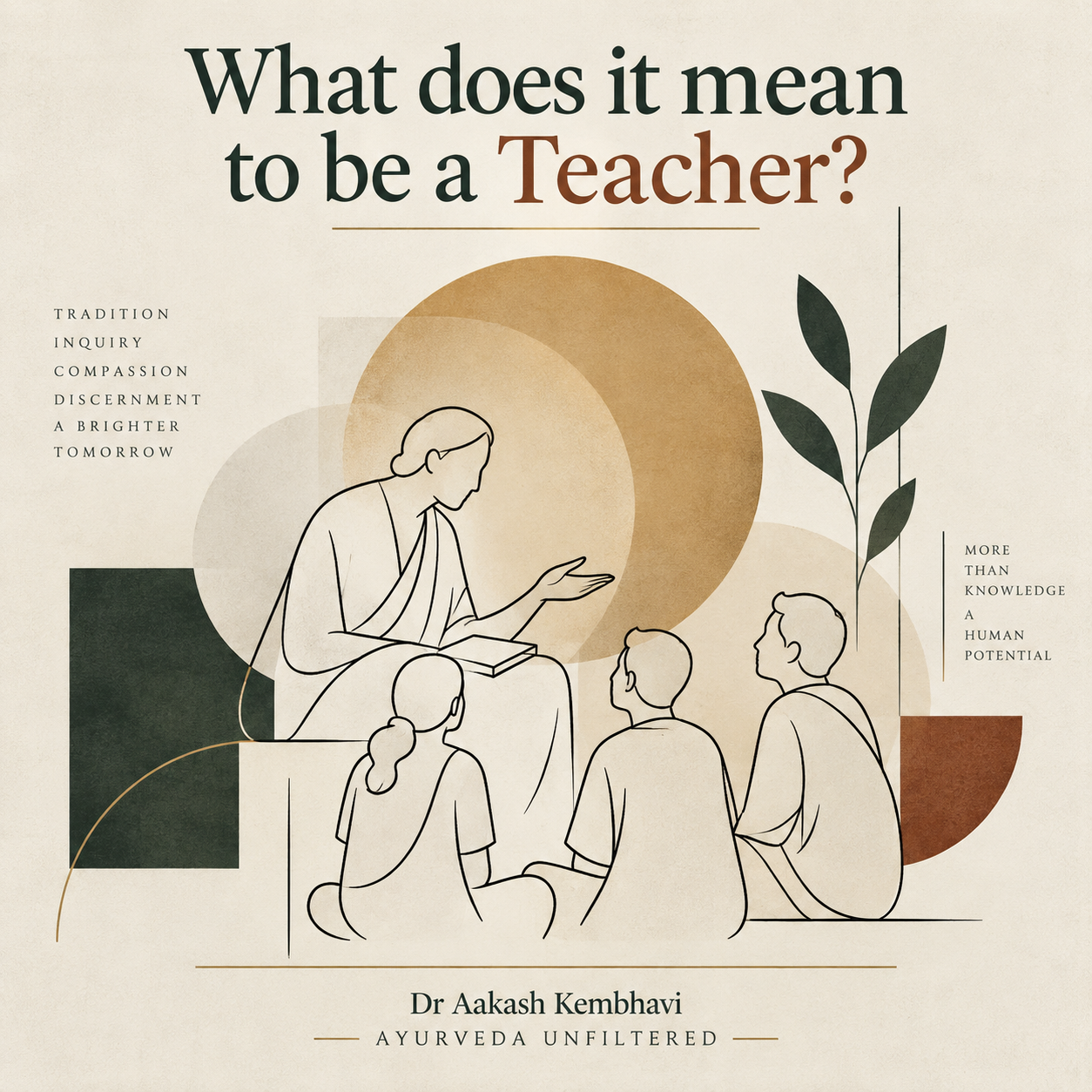
What Does It Mean To Be A Teacher? - A Teachers' Day Reflection — and a Reckoning for Ayurveda
Dr. Aakash Kembhavi
| **MD (Ayu-Shalya), PGDMLS, MS (Counseling & Psychotherapy) | Academician, Clinician & Researcher | Chief Editor, International Journal of Ayurveda** |
Disclaimer: The views expressed in this article are the author’s personal reflections and opinions. They do not represent the position of any institution he is affiliated with, and nothing here should be construed as medical advice. In the interest of transparency, this article was developed in collaboration with AI tools for research support, structuring, and drafting; the ideas, judgments, and conclusions expressed remain entirely the author’s own.
Every year on the fifth of September, India pauses — or performs a pause — to remember its teachers.
The date was chosen to honour Dr. Sarvepalli Radhakrishnan, philosopher, statesman, and above all, a teacher who believed the vocation was too sacred to be reduced to a profession.
It is worth sitting with the question he spent a lifetime answering, not as a ritual to be observed but as an inquiry to be lived: what does it actually mean to be a teacher?
“Teachers should be the best minds in the country.” — Dr. Sarvepalli Radhakrishnan
Radhakrishnan did not mean the most credentialed minds, or the most published, or the most administratively compliant. He meant minds capable of kindling other minds — the kind of intellect that a society trusts with the formation of its young, precisely because that formation determines everything else the society will become.
To be a teacher, in this sense, is to accept custodianship of a nation’s future before that future has any capacity to consent to the shaping. It is an extraordinary trust. It deserves an extraordinary seriousness.
Beyond the Garland and the Photograph
And yet, what does Teachers’ Day usually look like? A garland, a bouquet, a felicitation on a stage, a photograph for the college newsletter or the institution’s social media handle, a speech read out rather than felt, and by evening, life resumes exactly as it was. I say this not to belittle the affection behind these gestures — much of it is sincere — but to ask whether sincerity of feeling is being allowed to translate into sincerity of action. A celebration that changes nothing about how teachers are treated for the other three hundred and sixty-four days of the year is not a tribute. It is a photo opportunity wearing the clothes of a tribute.
“Teaching is the highest form of understanding.” — Aristotle
If teaching truly is the highest form of understanding, as Aristotle held, then a single day of applause is a strange way to acknowledge a lifetime spent in that pursuit. Meaningful observance would ask harder questions: Are our teachers paid enough to live with dignity? Are they given the time and autonomy to think, to research, to mentor deeply rather than merely deliver content? Are they respected as intellectual authorities, or merely as employees who must be managed, monitored, and audited? A celebration worthy of the name would answer these questions honestly, even when the honest answers are uncomfortable.
The Debt a Nation Owes and Rarely Pays
Nation-building is not accomplished by policy alone.
It is accomplished, generation after generation, in classrooms, wards, and laboratories, by teachers who convert raw curiosity into competence and competence into character.
Every doctor, engineer, scientist, administrator, and citizen capable of independent thought owes that capacity to some teacher who chose, often against poor incentives, to teach well rather than merely to teach.
“Education is the most powerful weapon which you can use to change the world.” — Nelson Mandela
Yet the profession that wields this weapon is chronically under-compensated and under-respected in India, and nowhere is this more starkly visible than in Ayurveda education.
Ayurveda teachers are entrusted with producing the healthcare professionals who will serve millions of patients who have no other recourse to affordable, accessible medicine.
That is not a modest responsibility — it is a public health responsibility of the first order. And yet the compensation, infrastructure, research support, and institutional respect extended to Ayurveda faculty routinely fall short of what this responsibility should command.
We cannot claim to value the outcome — healthy citizens, a credible system of medicine — while starving the process that produces it.
Ayurveda’s Teachers: From Role Models to Record-Keepers
This is where the reflection must turn inward, because the crisis in Ayurveda education is not only about money.
It is about what the profession of teaching has been allowed to become.
Ayurveda’s own epistemic tradition places the teacher — the Acharya, the Guru — at the very centre of knowledge transmission.
The classical texts do not describe a teacher as a content-delivery mechanism; they describe a relationship of observation, apprenticeship, and character formation, sustained over years, in which the student absorbed not just information but judgment.
“A teacher can never truly teach unless he is still learning himself.” — Rabindranath Tagore
Measure that ideal against the lived reality of an Ayurveda college teacher today, and the gap is difficult to look away from.
A very large share of a faculty member’s working life is now consumed by documentation: attendance registers, log books, internal assessment records, NAAC and NCISM compliance files, accreditation paperwork, portfolio uploads, and an ever-expanding list of forms whose primary audience is an inspection committee rather than a student.
None of this is inherently illegitimate — accountability matters — but when paperwork becomes the dominant use of a teacher’s time and attention, the teacher stops being a role model that students can align their aspirations to, and becomes, in effect, an administrative clerk who also happens to teach.
This is a tragedy with a particular irony.
Ayurveda, a system whose entire epistemological foundation rests on the authority and integrity of its teachers — Pramana as validated by the observation and reasoning of qualified Acharyas — is today the discipline where teachers are least free to embody that authority. We have built a regulatory apparatus so preoccupied with proving compliance on paper that it has left little room for cultivating the very quality — deep, demonstrated mastery — that the tradition was designed to transmit.
Is Ayurveda Serious About Producing Teachers at All?
Beneath the question of how teachers are treated lies a more foundational one: has the system ever seriously tried to produce them in the first place?
Ask a young BAMS or MD graduate who has just joined a college as a lecturer where they learned to teach, and the honest answer, in almost every case, is nowhere.
Subject knowledge is tested exhaustively — entrance examinations, dissertations, viva-voce boards — but the capacity to teach, to design a lesson, to assess fairly, to mentor a struggling student, is simply assumed to arrive automatically with the degree.
It does not.
“We teach who we are.” — Parker J. Palmer
This is, arguably, the single biggest gap in Ayurveda education today.
There is no dedicated component in the BAMS or MD curriculum, no mandatory certification, and no structured induction programme run by any regulatory authority that trains a subject expert to become a teacher.
We rigorously test whether a candidate knows Ayurveda; we almost never test, or even attempt to build, whether that candidate can teach it.
A capable clinician is simply handed a classroom and left to reproduce, from memory and instinct, whatever manner of teaching they themselves happened to be exposed to — good or bad.
This omission would be consequential in any discipline; in Ayurveda it is compounded by the nature of the knowledge itself.
The Guru-Shishya framework that Ayurveda claims as its own inheritance assumes a teacher deliberately trained not only in the Samhitas and in clinical practice, but in the art of transmission — questioning, demonstrating, correcting, and building clinical reasoning step by step.
To claim descent from that framework while offering no formal preparation for teaching is not a minor inconsistency. It is close to a contradiction.
If Ayurveda education is serious about producing quality teachers, this is where that seriousness would have to begin: a structured, mandatory pathway — however modest — through which every faculty member is trained in pedagogy, assessment, and mentorship before or soon after they start teaching. Its absence, more than any shortage of funds, may be the single largest reason the system keeps producing subject experts without reliably producing teachers.
What We Owe the Builders Who Came Before
It is worth remembering, soberly, how Ayurveda arrived at its present institutional strength at all.
Decades ago, a generation of dedicated scholars and clinicians, built colleges, hospitals, and training programmes essentially from scratch, with limited resources and none of today’s documentation apparatus.
They trained physicians through long clinical apprenticeship, direct mentorship, and painstaking scholarship — not through log books and compliance dashboards.
If those teachers had been made to spend their time filling forms instead of building institutions and training students, it is difficult to imagine Ayurveda occupying the position it holds today, however imperfect that position remains.
We are, in a very real sense, living off an inheritance that was built without the very apparatus we now insist is indispensable.
Professionalising Ourselves Out of Our Own Substance
There is a case to be made that in the race to professionalise — to look credible to regulators, to accreditation bodies, to a globalising health market — Ayurveda has traded away some of its soul.
We have built an elaborate machinery of standard operating procedures, quality manuals, and compliance frameworks, and in the process created something that increasingly resembles a monster we no longer fully control: a system optimised for demonstrating process on paper, running alongside — but not always intersecting with — the substantive, evidence-generating, mentorship-driven work that actually advances the discipline.
Meanwhile, the global Ayurveda and herbal products market is projected in the billions of dollars, and a great deal of institutional energy is now oriented toward that commercial opportunity rather than toward the scholarly and clinical foundations that alone can justify it.
Have we, then, missed the bus to do something genuinely meaningful with this moment of global attention? It is a question worth sitting with rather than answering defensively.
The Questions Teachers’ Day Should Really Provoke
- What research are we actually doing, and how much of it would survive scrutiny outside our own journals and conferences?
- Where are the institutions of excellence in Ayurveda that a young scholar could point to the way a physics student points to a great research university — places whose reputation rests on demonstrated rigour rather than accreditation status?
- Where are the role models — teachers whose clinical acumen, scholarship, and integrity are so evident that students organise their own ambitions around them, the way Radhakrishnan organised a nation’s idea of what a teacher could be?
- And, perhaps most uncomfortably, where is the clinical evidence — the kind that is generated patiently, published transparently, and able to withstand cross-disciplinary examination — that should by now underpin a system with such ancient claims to efficacy?
“The great teacher inspires.” — William Arthur Ward
These are not rhetorical flourishes. They are the actual measures of whether a teaching tradition is alive or merely administratively surviving. A tradition that cannot produce excellent institutions, credible research, visible role models, and defensible evidence is not being taught into the future — it is being processed into paperwork.
The Changing Student, and a Celebration in Need of Depth
There is a second, less discussed dimension to this reflection, and it concerns the student rather than the teacher.
The aptitude and attitude of students changes with every generation, and this generation’s shift may be the most consequential yet.
A student today no longer depends on a teacher as the primary, or even preferred, source of knowledge.
Artificial intelligence and online content have made information instantly retrievable, endlessly patient, and available at any hour of the day — qualities no single teacher, however dedicated, can match.
This does not make the teacher irrelevant, but it does make the older model of teacher-as-sole-authority obsolete, and it makes the actual challenge of teaching considerably deeper: a teacher today must earn relevance through judgment, mentorship, and clinical wisdom, not through simply gatekeeping information.
Compounding this is a cultural shift within universities themselves, which have, with good intentions, become increasingly student-friendly — more accommodating of circumstance, more forgiving of gaps, more reluctant to fail anyone. But when students become confident, almost as a matter of institutional guarantee, that they will not be failed, an important pressure that once sustained disciplined study quietly disappears.
A profession that trains healthcare providers cannot afford to lose that pressure without consequence, however kindly intentioned the reform behind its loss.
“A teacher affects eternity; he can never tell where his influence stops.” — Henry Adams
I say this having lived it directly, not as an outside critic.
In my own experience, it is students who plan and organise Teachers’ Day celebrations, and I have told them plainly, every year, that the celebration should be meaningful — that meaningful appreciation would show up as dedication in the classroom and the clinic, not only as a single day’s event. It rarely does, in the way I mean it.
The students mean well; their affection is genuine and warm, and I do not doubt it for a moment. But the essence, more often than not, gets diluted somewhere between the intention and the execution.
I say this without wanting to sound critical of everything the day stands for.
Teachers’ Day is, and should remain, a day where teachers feel appreciated and simply enjoy the warmth of their students’ company, and I am entirely in favour of that.
But a profession as old and as serious as Ayurveda surely deserves a celebration that holds fun and depth together, not one at the expense of the other.
There are, as always, exceptions — students whose dedication genuinely matches the occasion — and those exceptions are heartening. But they remain exceptions. Not, yet, the rule.
What a Meaningful Teachers’ Day Would Look Like
A worthy observance of Teachers’ Day in Ayurveda would not begin with garlands.
It would begin with structural honesty:
- reducing the documentation burden that consumes the hours teachers should be spending with students and in the clinic;
- compensating faculty in proportion to the public health responsibility they carry;
- rewarding demonstrated clinical and scholarly excellence rather than procedural compliance; and
- consciously rebuilding the conditions under which a teacher can once again become a role model rather than a record-keeper.
It would mean asking every institution, honestly, whether it is producing physicians or merely processing files that say it is.
To be a teacher, at its core, has never required an office, a title, or a compliance file.
It has always required the willingness to be fully present for another person’s becoming — to observe, correct, encourage, and, when necessary, to hold a standard the student cannot yet see for themselves.
Ayurveda knew this once, and built itself on teachers who lived it without needing to prove it on paper.
Recovering that spirit, not merely commemorating it once a year, would be the only celebration truly worthy of the name.
Share your thoughts in the comments below.
💬 Comments & Discussion