49 Out Of 192: AIAPGET Silence And Ayurveda Politics
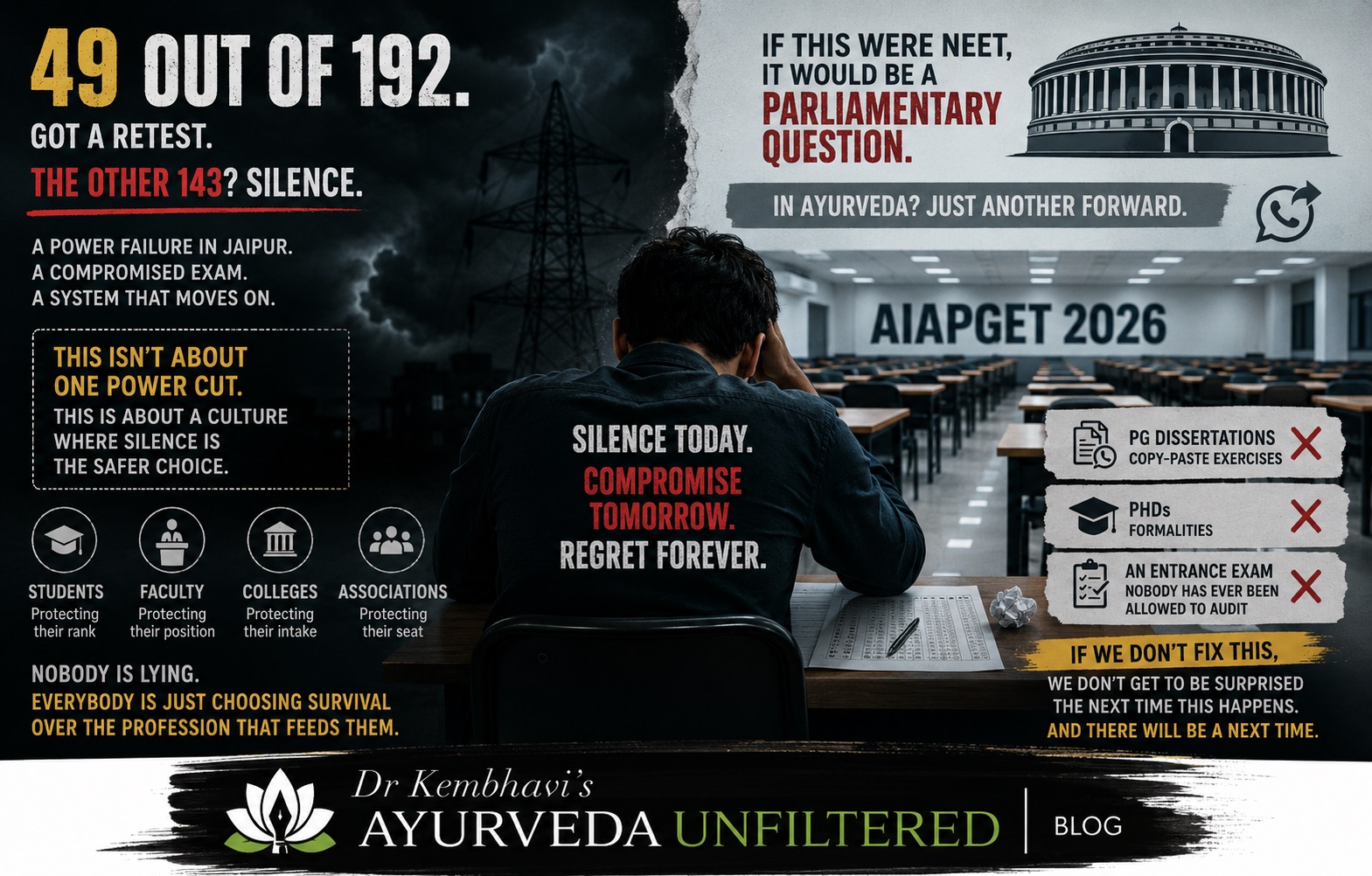
49 Out of 192: What the AIAPGET 2026 Silence Says About Ayurveda’s Real Curriculum — Survival
Dr. Aakash Kembhavi
| *MD (Ayu-Shalya), PGDMLS, MS (Counseling & Psychotherapy) | Academician, Clinician & Researcher | Chief Editor, International Journal of Ayurveda* |
Disclaimer & Disclosure
The views expressed in this article are the author’s personal opinions, formed over three decades of experience within Ayurvedic academia, and do not represent the position of any institution, organisation, or publication the author is affiliated with. This article discusses systemic and institutional patterns and does not make allegations against any named individual, college, or organisation; specific facts regarding the AIAPGET 2026 Jaipur centre incident are drawn from NTA’s own public statements and contemporaneous news reporting.
In the interest of transparency, this article was developed in collaboration with AI tools, which assisted with research, structuring, and drafting. The underlying idea, analysis, and final views and conclusions remain the author’s own
On 22 August 2026, the National Testing Agency conducted AIAPGET — the All India AYUSH Postgraduate Entrance Test — for 49,867 candidates across roughly 200 centres. At one of them, Shri Satya Sai PG College in Jaipur, the power failed at 10:20 am. Of the 192 candidates in that room, 49 could not finish. Some candidates who did continue later said the question paper had already been seen, discussed, and compromised during the outage. Three female students reportedly fainted from the heat and the stress. NTA’s response was to schedule a retest for the 49 who couldn’t complete the paper, and to suspend the empanelment of the private agency running the centre, pending a show-cause notice.
That leaves 143 candidates at the same centre, in the same compromised room, whose scores stand unchallenged. Candidates on social media asked the obvious question:** why only them? **
I want to ask a different, harder question, because the first one at least got asked out loud.
Where was the outrage from the rest of us — the tens of thousands of Ayurveda postgraduate aspirants, the faculties who teach them, the colleges that will absorb this year’s ranked list, the professional bodies that exist, on paper, to speak for this profession?
A malfunction like this in NEET produces parliamentary questions, prime-time debate, and Supreme Court hearings within days. In Ayurveda, it produced a few days of WhatsApp forwards and then silence. That gap is not an accident. It is the system working exactly as it was built to.
This Was Never Really About One Power Cut
A single equipment failure at a single centre is a logistics problem, and NTA’s own handling of it — a show-cause notice, a suspended empanelment, a scheduled retest — was procedurally reasonable as far as it went. What it is not is an isolated incident in a system with an otherwise clean record.
Anyone who has spent time with AIAPGET question papers over the last several admission cycles — and I have, year by year, item by item — already knows this is a testing apparatus that has never been made to answer for its own quality: papers padded with rote recall and general-knowledge trivia in place of clinical reasoning, mapping and matching exercises that test memorisation rather than diagnostic thinking, and no published, transparent accounting of item quality from the agency that sets the gate for every Ayurveda postgraduate seat in the country.
A single power cut in Jaipur is a symptom.
The disease is that nobody with the standing to demand better has ever been made to.
Where Is Everyone?
Ask that plainly, sector by sector, and the answers are uncomfortable.
- Students, who have the most to lose from a compromised paper, mostly stayed quiet — not out of ignorance, but because a minority who prepared seriously have little incentive to demand a fair re-test that could just as easily reshuffle their own hard-earned rank downward. A malfunction at someone else’s centre is, coldly, an opportunity for someone else’s cutoff to move.
- Colleges and principals, whose intake depends on this exam producing a ranked list on schedule, have no institutional incentive to question the agency that produces it — today’s silence is tomorrow’s smooth admission cycle.
- Faculty associations and professional bodies, several of which sit close enough to AYUSH’s policy circles to be invited to its committees, consultations, and ceremonial platforms, have far more to lose from being seen as adversarial to the Ministry or the NTA than they have to gain from defending 49, or 192, students they will never meet.
- Universities and regulators — the National Commission for Indian System of Medicine among them — have shown no appetite for an independent, published audit of AIAPGET’s item quality or its centre-management standards, year after year, cycle after cycle.
Every one of these silences is individually defensible as “not my problem” or “not worth the risk.”
Collectively, they are the profession’s actual position on its own entrance examination: acceptable as it is, indefinitely.
The Politics of Survival
I have said this before and I will say it again, because thirty years inside this system have not given me a reason to soften it: accountability, transparency, and integrity are not values this system currently rewards.
What it rewards is quid pro quo — quiet compliance in exchange for continued access.
A faculty member who stays silent about a diluted PG viva, a padded question bank, or a college’s convenient look-the-other-way culture is the faculty member who gets the next examinership, the next syndicate seat, the next research-guideship.
A faculty member who says any of this publicly, by name, in the wrong forum, finds those same doors closing quietly and without explanation.
Nobody has to conspire for this to work. The incentive structure does the work on its own, and everyone inside it learns the rules within their first year without being told them directly.
This is precisely why PG and PhD in Ayurveda have, in too many places, become a formality rather than a filter.
Dissertations assembled by compilation and repetition are not a scandal because nobody notices — they are not a scandal because the people positioned to object are the same people who benefit from a low bar: it produces more eligible candidates for faculty appointment, more smooth promotions, more institutions meeting their numerical staffing requirements without the friction of an actual research culture.
A profession that will not defend the integrity of its entrance exam is, unsurprisingly, the same profession that has let its research degrees drift into ceremony. The two are not separate failures. They are the same failure, at two different gates.
Everyone’s Survival Is Not, Individually, the Villain
I want to be fair about one thing, because it matters to the argument rather than softening it: a college principal protecting enrolment, a faculty member protecting a livelihood, a student protecting a hard-won rank — none of these instincts is inherently corrupt.
People are entitled to look after their own survival, especially in a profession that has never paid them particularly well or protected them particularly reliably.
The indictment is not that people act in their own interest.
It is that this system has organised itself so that acting in your own interest and staying silent about a compromised entrance exam, a rubber-stamped dissertation, or a captured professional association are, almost always, the exact same act.
When self-interest and institutional silence point in the same direction this consistently, the system is not merely tolerating politics — it is being run by it.
Where Is the GenZ of Ayurveda?
This is the question I have asked before and will keep asking, because AIAPGET 2026 is only the latest occasion to ask it again.
Ayurveda is, today, a fractured community — not united by a shared standard, a shared grievance mechanism, or a shared willingness to be inconvenient to the people who hold power over its colleges and its careers.
If a national entrance test can be compromised for nearly two hundred candidates and generate a fraction of the outrage a comparable NEET failure would draw automatically, the fracture is not hypothetical.
It is measurable, in the silence itself.
And if the colleges, principals, faculties, and universities who are supposed to stand between students and this kind of institutional failure will not do it even when the facts are this clear and this public, I see no reason to be hopeful about Ayurveda correcting itself as a system, from the inside, on its own timeline.
What Would Actually Have to Change
- A published, centre-by-centre disclosure from NTA of every disruption — power, technical, or procedural — across every AIAPGET cycle, not just the one that went public on social media.
- An independent, standing item-quality audit of every AIAPGET paper, conducted by people with no appointment or promotion riding on the outcome, with findings made public before the next cycle is set.
- A genuine, protected national grievance and advocacy body for Ayurveda PG aspirants — one that cannot be quietly defunded, disinvited, or sidelined the moment it becomes inconvenient to a college, an association, or the Ministry.
- Explicit protection for faculty who flag irregularities in exams, dissertations, or appointments — so that the professionally safe choice and the ethically correct one stop being opposites.
- A decoupling of PG/PhD completion from automatic eligibility for faculty appointment and promotion, enforced through external, rotating examiners with no institutional stake in the outcome.
None of this happens because a blog post asks for it.
It happens, if it ever does, when enough people inside this profession decide that protecting Ayurveda’s credibility is worth more to them than protecting their own position within a system that currently asks them to choose between the two.
Until that calculation changes for enough people, the next power cut, the next padded paper, the next rubber-stamped dissertation will draw exactly the response this one did: a few days of WhatsApp outrage, and then business as usual.
That is not a prediction. Thirty years in, it is simply what I have watched happen, every single time.
.
Share your thoughts in the comments below.
💬 Comments & Discussion