The Faculty We Lose
The Faculty We Lose, and the Faculty We Never Even Count
What a LinkedIn infographic on faculty attrition reveals by omission, when read against the reality of Ayurveda education
An Ayurveda Unfiltered Perspective
Dr. Aakash Kembhavi
| MD (Ayu-Shalya), PGDMLS, MS (Counseling & Psychotherapy) | Academician, Clinician & Researcher | Chief Editor, International Journal of Ayurveda |
Disclaimer: The views expressed in this article are personal observations and opinions of the author, formed through years of engagement with Ayurveda education and academia. They do not represent the official position of any institution, journal, or organisation the author is affiliated with, and are offered in the spirit of constructive, reform-oriented dialogue.
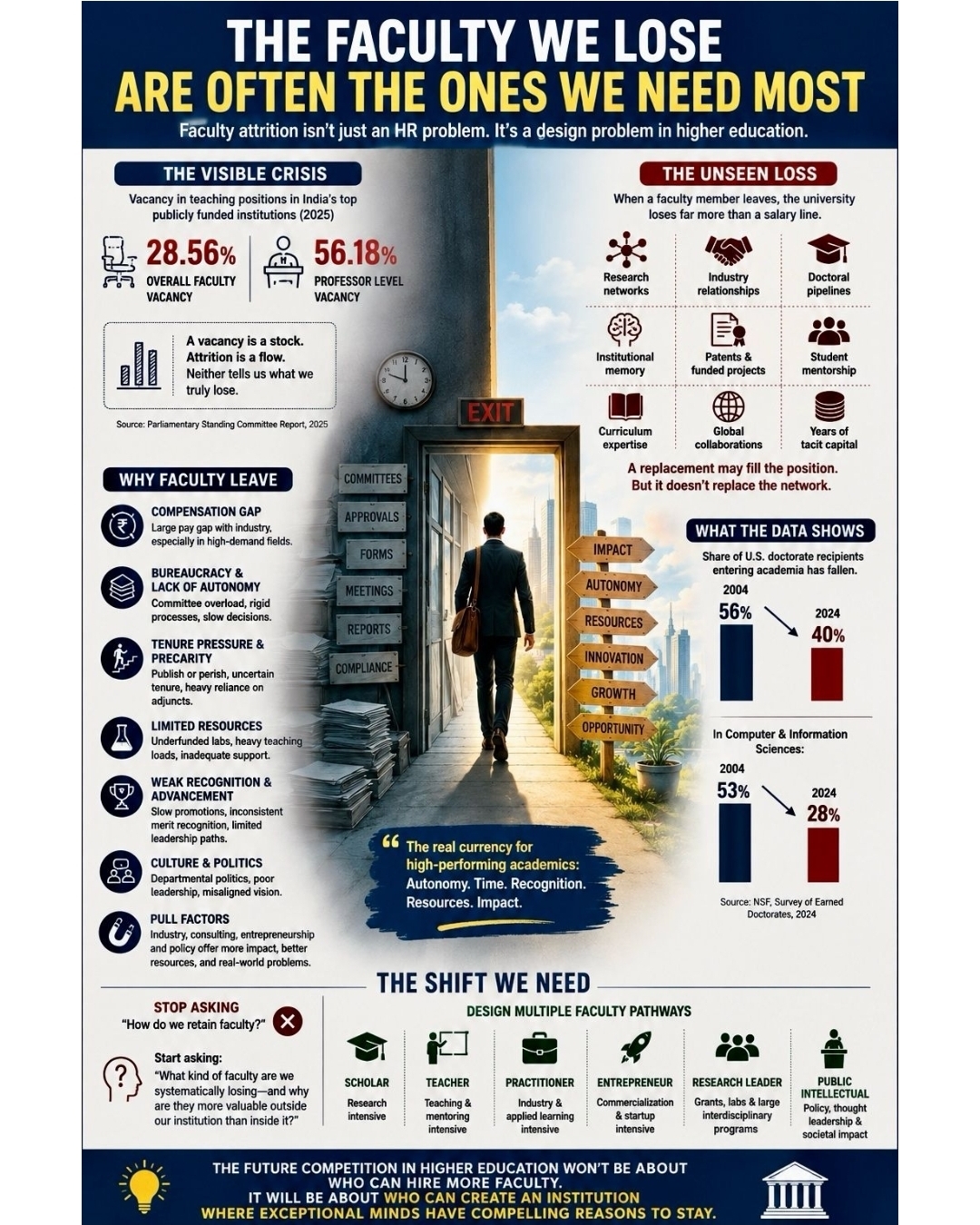
A LinkedIn post by Rajneesh Wadhwa crossed my feed recently, built around a sharp infographic on faculty attrition in higher education. It made a case that will be familiar to anyone who has watched a talented colleague quietly hand in their resignation: universities are losing exactly the faculty they can least afford to lose, and they are losing them for reasons that have almost nothing to do with money and almost everything to do with design. Compensation gaps matter, the data shows, but so do bureaucracy, tenure precarity, weak recognition, departmental politics, and a chronic mismatch between what institutions say they want (entrepreneurial, research-driven, industry-connected faculty) and what they actually build for those people to work inside (compliance regimes, committee overload, approval chains). The share of US doctorate holders entering academia fell from 56% in 2004 to 40% in 2024, and in computer and information sciences, from 53% to 28%. The post’s conclusion was blunt: stop asking how to retain faculty, and start asking what kind of faculty you are systematically losing, and why they are more valuable outside the institution than inside it.
It is a good question. It is also a question that Ayurveda academia, as a system, is not asking, and largely cannot ask, because the machinery to ask it does not exist.
A Diagnosis Built for a System That Interrogates Itself
What struck me most about the infographic was not the data. It was the assumption sitting quietly underneath it: that the institution wants to know. The entire framework, self-audit, exit-reason analysis, doctorate placement tracking, presupposes a system with enough self-awareness and enough incentive to ask uncomfortable questions about itself. Mainstream research universities, for all their well-documented dysfunction, at least have the apparatus, faculty surveys, sponsored research offices, tenure review committees with some external benchmarking, that produces this kind of data in the first place. The Parliamentary Standing Committee report the post cites, the NSF Survey of Earned Doctorates, these exist because someone, somewhere, is paid to track attrition as a problem worth measuring.
Ayurveda education runs on a different operating system entirely. Faculty attrition is not tracked as attrition. It is absorbed, silently, into a churn that nobody frames as loss because the yardsticks that would register it as loss were never installed. Research output, patents, funded projects, doctoral pipelines, global collaborations, these are the metrics by which the infographic measures what a departing faculty member takes with them. In most Ayurveda colleges, these metrics are not weak. They are largely absent as institutional priorities. You cannot lose what you never counted as an asset.
What Gets Measured, and What Gets Rewarded
This is the more uncomfortable half of the comparison. The infographic’s six pull factors, compensation, bureaucracy, tenure pressure, limited resources, weak recognition, and culture and politics, are presented as things a well-intentioned institution could, in principle, fix. Ayurveda colleges face versions of all six. But they face something the infographic does not even list as a category, because in most research-driven systems it would be considered an aberration rather than a norm: retention and advancement that run on loyalty, seniority, and political patronage rather than on scholarly merit.
Exceptions exist, and they matter. There are Ayurveda academicians doing rigorous clinical research, publishing honestly, mentoring the next generation of scholars against real institutional headwinds. But the reality for most is that career progression is not primarily a function of who publishes, who innovates, who builds a lab or a clinical protocol or a genuinely new curriculum. It is a function of who is affiliated with the right management, the right political patron, the right lineage of institutional favour. A faculty member who challenges an outdated syllabus, questions a management decision, or points out that a claimed clinical outcome lacks evidence is not managing “institutional friction” in the polite language of an HR infographic. They are, in a meaningful number of institutions, managing a genuine risk to their continued employment.
The Structural Peculiarities That Make Ayurveda Academia Unique
Several forces compound to make faculty retention in Ayurveda a fundamentally different problem from the one described in mainstream higher-education literature, and each deserves to be named plainly rather than gestured at.
Affiliation and ownership structures that concentrate power
Many Ayurveda colleges are privately owned or run by trusts, affiliated to universities that exercise only nominal academic oversight. Where a university’s writ runs thin, the management’s writ runs thick, and management incentives are rarely aligned with research productivity or academic freedom. They are aligned with enrolment numbers, fee collection, and institutional reputation as measured by NCISM compliance checklists, not by scholarly output.
Ideological and identity-based conformity
Ayurveda carries a civilizational and nationalist charge that most academic disciplines do not. Affiliation to a particular ideology of tradition, an uncritical patriotism about “Indian knowledge systems,” and a reflexive defensiveness against anything read as Western scientific scrutiny, function as unwritten loyalty tests. A faculty member who insists on evidence-based rigor, who asks for RCT-quality data before a claim is published, can be read not as a good scientist but as insufficiently devoted to the tradition. This is a career hazard that a computer science department simply does not have.
Patriarchal and hierarchical practices
Seniority, gender, and deference to institutional elders often outweigh demonstrated competence in decisions about promotion, PG guideship, or committee leadership. Younger faculty, and particularly women faculty, frequently describe a ceiling that has nothing to do with their CV.
Absence of scientific temper as an institutional value
Reverence for tradition and heritage is, on its own, a reasonable starting posture for a classical system of medicine. But when it curdles into resistance to critical inquiry, when questioning a Samhita-derived claim is treated as disrespect rather than scholarship, faculty who came into academia to build an evidence base for Ayurveda find themselves institutionally unwelcome rather than institutionally supported.
A one-way, top-down regulatory culture
A small number of departments and apex bodies operate on the assumption that they alone understand what Ayurveda education needs, issuing curriculum and compliance mandates with minimal consultation of the faculty who will have to teach under them. Feedback loops run downward only.
No functioning grievance or suggestion mechanism
This is perhaps the starkest structural gap. Mainstream universities have, at minimum, an ombudsperson, a faculty senate, an anonymous survey, something. Most Ayurveda colleges have no institutionalised channel through which a faculty member’s dissent, suggestion, or complaint can travel upward without personal risk. Silence is not consent in these systems. It is often the only available strategy for survival.
A Public Health System Behaving Like a Private Wellness Brand
The deepest irony in all of this is what gets lost in the noise: Ayurveda is, formally, a public healthcare system. NCISM-regulated colleges train doctors who staff government dispensaries, PHCs, and AYUSH wings of public hospitals, serving patients who often have no other affordable option. That public mandate should, in theory, generate the same institutional self-scrutiny that any public health system owes the population it serves: are we training competent clinicians, are we retaining the faculty capable of producing that competence, are our graduates safe to practice.
Instead, that public accountability is largely absent from the conversation, while a billion-dollar herbal and wellness industry is promoted without embarrassment, often by the very academic and regulatory ecosystem that should be holding it to evidentiary standards. Faculty who could be building the research infrastructure to genuinely validate Ayurvedic interventions, who could be the pipeline this industry needs to justify its claims with real data, are instead pushed toward decorative roles: attending conferences that function as networking-cum-marketing events, signing off on products with tenuous evidence, staffing a system whose real currency is brand visibility rather than clinical rigor. The patients, and the public health mandate they represent, are the first casualty of this arrangement. The faculty capable of correcting it are the second.
The 43,722 Number: A Case Study in What Volume Doesn’t Tell You
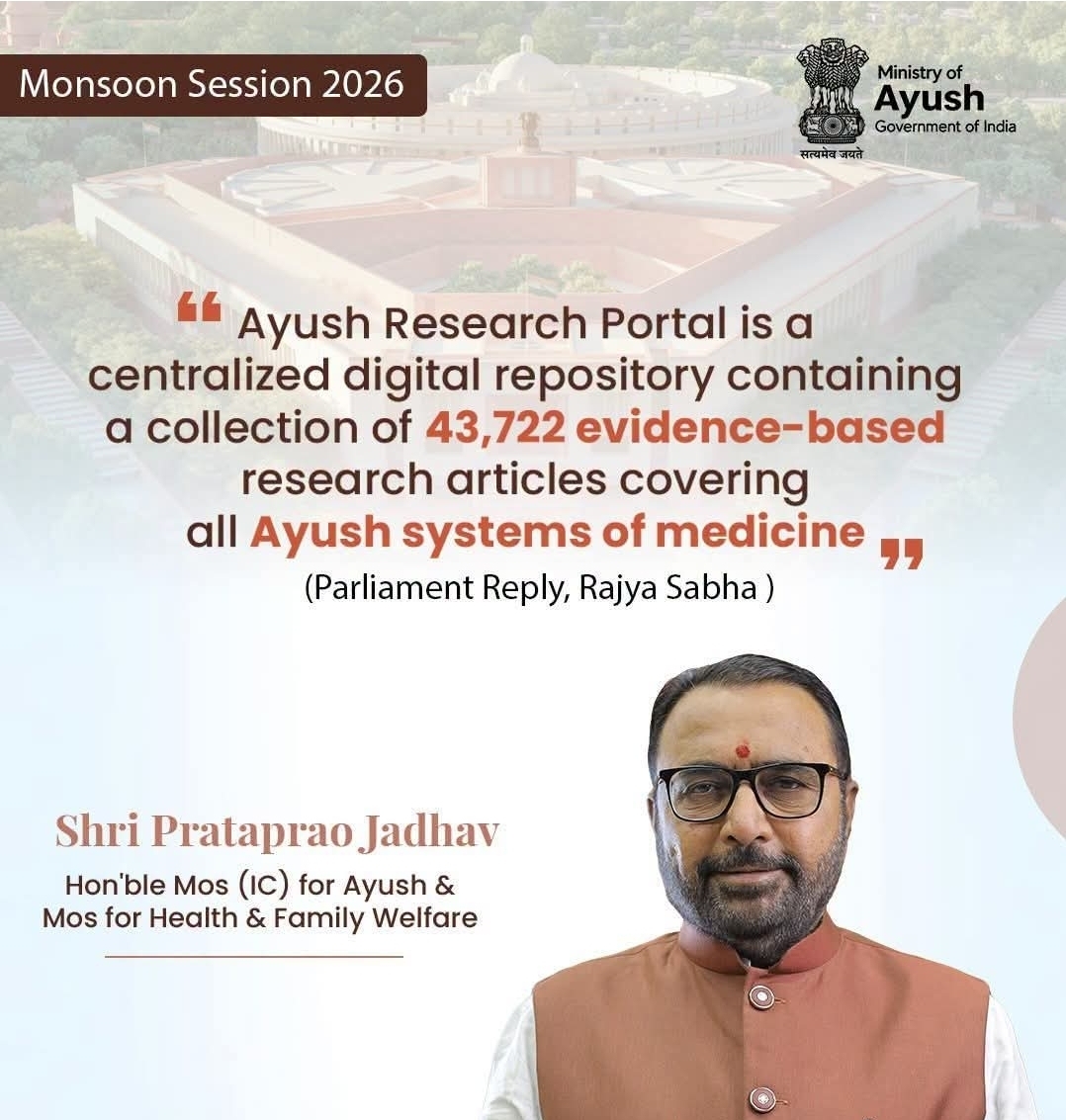
A recent government social media post, timed to the Monsoon Session 2026 of Parliament, offers an almost perfect illustration of the gap this article is describing. In a written reply to the Rajya Sabha, the Ministry of Ayush stated that its Ayush Research Portal is a centralised digital repository containing 43,722 evidence-based research articles covering all Ayush systems of medicine. The figure is real, the reply is real, and the portal itself, developed and maintained by the Central Council for Research in Ayurvedic Sciences since 2011, is a genuinely useful piece of public research infrastructure. None of that is in dispute.
What deserves scrutiny is the word doing the heaviest lifting in that sentence: evidence-based. The portal’s own contributors have already done the analysis that the promotional graphic conveniently skips. A bibliometric study of the portal’s Ayurveda clinical-trial holdings, carried out by CCRAS researchers themselves and published in the journal Ayu in 2023, applied the World Health Organization’s own evidence-grading framework, Grade A for randomised controlled trials, Grade B for well-conducted clinical studies without randomisation, Grade C for expert opinion, case reports, and single-arm dissertation-style work, to nearly four thousand indexed Ayurveda articles. The result: only 3.69% of Ayurveda articles in the portal qualified as Grade A evidence. Grade C articles, the lowest tier, the tier the WHO framework explicitly defines as indicating an absence of directly applicable studies of good quality, made up 77.74% of the total. The study’s own authors, writing in an Ayush-affiliated journal, called this an abysmal percentage of grade-A category articles and attributed the flood of low-grade work to two familiar causes: MD dissertation research conducted as single-arm studies with no comparator, and journals willing to publish with minimal editorial scrutiny in exchange for a fee.
The same study found that of the top twenty journals supplying most of the portal’s content, only five are indexed on any internationally recognised platform such as PubMed or Scopus. Fifteen of the twenty most prolific sources of Ayurveda’s own research base cannot currently be found by a researcher anywhere else in the world.
This is not an argument against the portal’s existence, or against the Ministry’s willingness to cite its scale in Parliament. It is an argument against mistaking a repository’s size for the research culture it claims to represent. A number like 43,722 photographs well. It answers a parliamentary question and travels well on Instagram. But it says nothing about whether the faculty who authored those articles were given the protected time, statistical support, ethics infrastructure, and institutional incentive to run a properly randomised trial rather than a retrospective case series completed alongside a full teaching load and zero research funding. The infographic this piece opened with argued that mainstream academia’s real failure is measuring publications while ignoring the friction that makes rigorous publication possible. Ayurveda’s version of that same failure is subtler and, in its own way, more revealing: it has built a portal sophisticated enough to grade its own evidence by WHO standards, published that grading in its own journal, and then continued to cite the raw count in Parliament as though the grading had never happened. The system’s most honest internal critique and its most public self-promotion coexist without apparently speaking to each other, which is, in miniature, the exact institutional pattern this article has been describing.
The Unseen Loss, Ayurveda’s Version
If we borrow the infographic’s own framework and ask what an Ayurveda institution actually loses when a serious faculty member leaves, the list looks different from the original, and arguably more consequential, because so little of it was ever backed up elsewhere in the system.
- Clinical protocols and case documentation built over years of practice, rarely digitised, rarely institutionalised, and gone the day the faculty member walks out.
- The rare capacity to write a defensible research methodology in a system where most PG theses are, by faculty’s own private admission, not publishable science.
- Mentorship for the small number of students who wanted something more rigorous than rote memorisation of classical texts.
- Institutional memory of what was tried, what failed, and why, which in the absence of documentation simply evaporates.
- Credibility with the handful of international collaborators or journals willing to take Indian Ayurveda research seriously, credibility that took a career to build and cannot be reissued to a replacement hire.
A vacancy gets filled. A replacement is found, usually quickly, because Ayurveda produces far more BAMS and MD graduates than there are meaningful academic posts to absorb them. But a replacement, as the original infographic rightly says of any faculty exit, does not replace the network. In Ayurveda’s case, it often does not even replace the will to build one.
What Ayurveda Institutions Should Be Asking Instead
The mainstream infographic’s reframed question, what kind of faculty are we systematically losing, and why are they more valuable outside the institution than inside it, deserves an Ayurveda-specific companion question, one the system has never had to answer publicly because no one has required it to: what kind of faculty are we systematically silencing, and what does their silence cost the patients we exist to serve?
A genuine shift would require Ayurveda colleges and their affiliating universities to build the very apparatus the infographic takes for granted, exit interviews that are actually analysed, a grievance mechanism with teeth, promotion criteria that reward evidence-based clinical scholarship over institutional loyalty, and a public acknowledgment that a discipline claiming to serve public health cannot indefinitely subordinate its academic integrity to the commercial interests of the wellness industry it has come to resemble. None of this requires abandoning tradition. It requires the same thing every functioning academic discipline requires: the humility to ask what it is doing wrong, and the institutional courage to let the answer change something.
Until that apparatus exists, Ayurveda academia will keep losing precisely the faculty it needs most, not to industry, as the infographic describes for mainstream academia, but to attrition of a quieter kind: disillusionment, burnout, and the slow realisation that the system was never built to want what they had to offer.
Share your thoughts in the comments below.
💬 Comments & Discussion